Voltage Imbalance in Solar Arrays
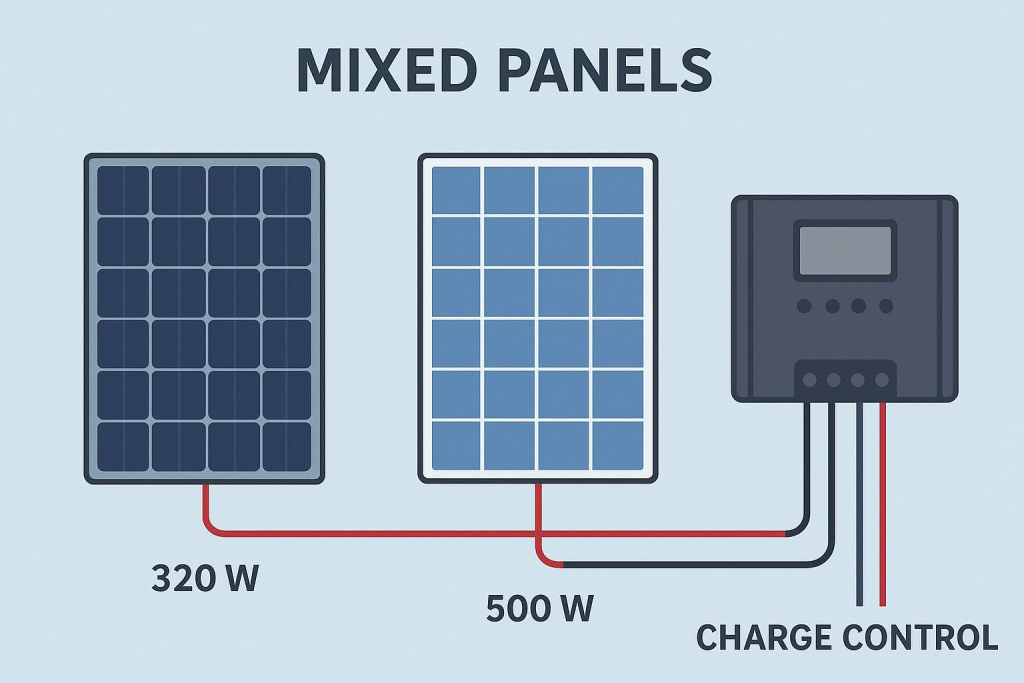
(One Controller, Mixed Panels)

- Introduction
- Why Voltage Imbalance Happens
- What Happens in Series (the worst-case scenario)
- What Happens in Parallel
- Why Age Matters So Much
- Effect on the Charge Controller
- When Mixing Panels Can Be Done Safely
- Conclusion
Introduction
We get called out for solar upgrades all the time, it makes up about half of our work. Just recently, we had a customer who wanted to add a second solar array to an older Magnum Energy system running a PT100 charge controller. Their existing array is made up of eight 320-watt panels, and now they’re looking to add a pole-mount array to the same controller.
The challenge is that their original 320-watt panels aren’t being produced anymore. You might still find them, but the cost would be much higher than buying something like modern 500 to 700 watt panels. The PT100 can easily handle more power, in fact, it can easily take on double what they’re currently feeding it, but adding mismatched panels to the same controller introduces a very common problem we see all the time.
Why Voltage Imbalance Happens
Why mixing old and new panels is almost always a bad idea
Panels are designed to operate at a very specific voltage sweet spot (their Vmp). A charge controller uses MPPT tracking to find that sweet spot for the entire array.
But if you blend panels with different sweet spots:
The MPPT can only choose ONE voltage for the whole array.
That means:
- One panel may want to run at 40V
- Another wants to run at 36V
The MPPT picks one point, so one panel is always forced to operate off its ideal voltage, which reduces power from both. When you connect different solar panels to the same charge controller, especially in series, you create a voltage imbalance. This imbalance comes from the panels having different electrical characteristics, especially:
- Different Voc (open-circuit voltage)
- Different Vmp (voltage at max power)
- Different Imp (current at max power)
- Different wattages and cell efficiencies
- Different degradation levels (older panels produce less)
Even small differences force the system to operate at the limit of the weakest panel, which drags down the total production.
What Happens in Series (the worst-case scenario)
When panels are wired in series:
- The current is limited by the panel with the lowest current (Imp).
- The voltage is limited by the MPPT choosing the wrong Vmp.
So a newer, higher-output panel gets pulled DOWN to match the older, weaker one.
Example:
- New panel Imp: 15A
- Older panel Imp: 11A → Your whole string now produces 11 amps, even if the new one could do 15.
You permanently lose solar production.
What Happens in Parallel
Parallel wiring removes the current limitation, but:
- Panels still have different voltages (Vmp)
- The MPPT again must choose one voltage
So even in parallel, mismatched Vmp panels run sub-optimally.
Also, newer panels may “back-feed” older, lower-voltage panels, creating heat loss or diodes triggering.
Parallel is less bad, but still not recommended unless the panels are VERY close in specs.
Why Age Matters So Much
Older panels naturally produce:
- Lower voltage
- Lower current
- Lower efficiency
So if you mix:
- One brand new, shiny, 600W panel
- One worn-out 250W panel from 2011
The new one MUST run at the performance level of the old one. It’s like putting a brand-new athlete and a retiree in a three-legged race, the slower runner sets the pace.
Effect on the Charge Controller
When mixed panels force the MPPT to run at non-optimal voltages:
- Energy harvest drops
- Controller runs hotter
- Controller may fail earlier
- Tracking becomes less stable, especially in variable light
Some controllers (Victron, Schneider) warn that mixed panel specs cause reduced performance or unstable MPPT tracking.
- You lose 10–40% production instantly
- You shorten equipment life
- You risk tripping bypass diodes
- You create inconsistent voltage that the controller has to fight
- The new panels never perform at their rated output
The cost savings of “using old panels” is rarely worth the performance hit.
When Mixing Panels Can Be Done Safely
Only when you use separate independent charge controllers.
Example:
- Old array → 150/60 MPPT
- New array → second 150/60 MPPT
Combining outputs on the DC battery side is fine. Each MPPT gets to track its OWN voltage sweet spot. You lose no energy.
This is exactly what we do on cabins with older arrays and new upgrades. Its unfortunate that the old controller cannot be doubled unless you max it out within a year or so of your installation. You test out your array and if you want more power you do this in the earlier stages of your system.
Mixing panels is like running two different types of batteries in the same flashlight. The flashlight is forced to operate at the level of the weakest battery.
With solar panels, the whole array drops to the voltage and current of the weaker or older panel. You lose power, and the MPPT can’t do its job properly.
Conclusion
Upgrading solar systems is becoming more and more common, but mixing old and new panels on the same controller can create performance issues that just aren’t worth the trouble. Even though the PT100 can easily handle more power, the voltage mismatch between older 320-watt panels and newer 500-watt panels means the whole array will never perform the way it should. In situations like this, the most reliable solution is to add a second controller so each array can operate at its own optimal voltage. It keeps the system efficient, protects the equipment, and gives the customer the full benefit of their upgrade.
Over the years, I’ve learned to always design with the future in mind. I usually ask customers whether they plan to upgrade within the next year or so. If the answer is no, then the best strategy is to max out the existing controller now. Later, five years down the road when panel technology and sizes have changed, they can simply add another controller for the new array. This approach avoids mismatched panels, reduces headaches, and keeps the system performing exactly the way it was meant to.
IOTG SOLAR LTD 5 Critical Mistakes To Avoid Before Buying Solar.pdf
For individuals seeking consultation, education, or assistance in system designs related to grid-tie or off-grid solar applications, IOTG Solar stands ready to help. Our team is available to address questions, provide valuable insights, and offer support at every stage of the solar energy journey. Feel free to reach out to IOTG Solar anytime for expert assistance and comprehensive solutions tailored to your specific needs.
IOTG Solar…
Keeping you powered through education.