Victron Virtual Switch
Using the Victron Virtual Switch to Automatically Control a Generator
- Introduction
- What Is the Victron Virtual Switch?
- Why Battery Voltage Matters
- How I Use the Virtual Switch to Control a Generator
- Important Limitation: 2-Wire Start Only
- No Quiet Time … Voltage Rules Everything
- Conclusion
Introduction
One of the biggest challenges with off-grid power isn’t making electricity, it’s knowing when to make it.
After recently setting up a Virtual Switch in a Victron MultiPlus, it quickly became clear that this is an excellent way to automatically control a generator while protecting your batteries. It’s simple, built in, and requires no additional hardware. However, there is a catch, and it’s an important one to understand before relying on it in a real-world off-grid system.
Generators are a great backup, but manually starting and stopping them gets old fast. Worse, people either forget to start them in time or have any sort of control of this. Also can run them longer than necessary, wasting fuel and putting unnecessary hours on the machine.
This is where the Victron Virtual Switch really shines.
What Is the Victron Virtual Switch?
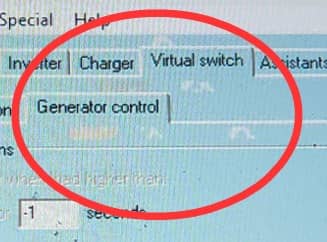
The Virtual Switch is a software-based relay inside Victron inverters (like the MultiPlus and Quattro). Instead of relying on physical switches or external controllers, it allows the inverter to make decisions based on real system conditions, most commonly battery voltage.
In simple terms:
- The inverter monitors the batteries
- When voltage drops too low, it triggers an output
- That output can be used to control a dry contacty relay to start a generator
- Once the batteries recover, the relay opens and the generator is shut off automatically
No babysitting required.
Why Battery Voltage Matters
Battery voltage is one of the most reliable indicators of system health, especially in off-grid systems.
For example:
- A 48V lithium system dropping below 48.5V under light load may indicate it’s time to recharge
- A lead-acid system hitting low voltage repeatedly can significantly shorten battery life
Using the Virtual Switch allows you to protect your batteries, not just keep the lights on.
How I Use the Virtual Switch to Control a Generator
In most setups, the Virtual Switch controls a relay output on the inverter. That relay doesn’t power the generator directly, it simply acts as a signal.
Here’s the typical flow:
- Battery voltage drops to a preset level
- The Virtual Switch closes the relay
- The relay sends a start signal to:
- A 2-wire generator start input, or
- An external auto-start controller
- The generator starts and supplies AC power
- The inverter begins charging the batteries
- Once voltage recovers to a higher preset level:
- The relay opens
- The generator shuts down
This hysteresis (low voltage start / higher voltage stop) prevents rapid cycling and keeps everything smooth and predictable.
Important Limitation: 2-Wire Start Only
The Virtual Switch is designed for 2-wire start generators only.
It is not suitable for 3-wire start generators, which require momentary start and stop signals. For those systems, Victron provides a Generator Start/Stop Assistant instead.
That assistant can control 3-wire generators, but it also has limitations:
- It does not offer a true quiet-time feature
- It still relies heavily on voltage-based logic
- It adds complexity compared to the Virtual Switch
So it’s important to match the control method to the generator type from the beginning.
No Quiet Time … Voltage Rules Everything
Another critical point: The Virtual Switch does not respect quiet-time hours.
If battery voltage drops below the set threshold:
- The generator will start
- It doesn’t care if it’s midnight
- It doesn’t care if you’re sleeping
- It doesn’t care about noise bylaws
This makes it ideal for:
- Remote cabins
- Industrial or agricultural systems
- Locations where generator noise is not restricted
But it is not appropriate for quiet-time locations unless you’re comfortable with that tradeoff.
Conclusion
The Victron Virtual Switch isn’t flashy, but it’s one of the most effective tools for building a reliable, low-stress off-grid system.
It:
- Comes free with the inverter
- Requires no additional devices
- Automatically manages generator runtime
- And above all else, protects your batteries
If your system uses a 2-wire generator and quiet-time restrictions aren’t a concern, this is one of the simplest and smartest upgrades you can make.
It’s also worth noting that this concept isn’t unique to Victron. The new breed of inverters entering the market, hybrid units and all-in-one inverter/charger/solar-controller systems with built-in breakers and Wi-Fi communication dongles, most include the same relay-based start/stop capability already built in. The idea of using real system conditions to control a generator is quickly becoming the standard, not the exception.
The technology may look different on the outside, but the goal is the same: protect the batteries, reduce stress on the system, and let the equipment do the thinking for you.
IOTG SOLAR LTD 5 Critical Mistakes To Avoid Before Buying Solar.pdf
For individuals seeking consultation, education, or assistance in system designs related to grid-tie or off-grid solar applications, IOTG Solar stands ready to help. Our team is available to address questions, provide valuable insights, and offer support at every stage of the solar energy journey. Feel free to reach out to IOTG Solar anytime for expert assistance and comprehensive solutions tailored to your specific needs.
IOTG Solar…
Keeping you powered through education.