The End of Legacy Off-Grid Inverters
Why classic platforms are fading, and why hybrid all-in-one systems are taking over
- Introduction
- Why Legacy Gear Is Being Displaced
- Cost and Value Are Shifting, Too
- Why Victron Is Still in the Game
- When Smaller Systems Still Make Sense
- Conclusion
Introduction
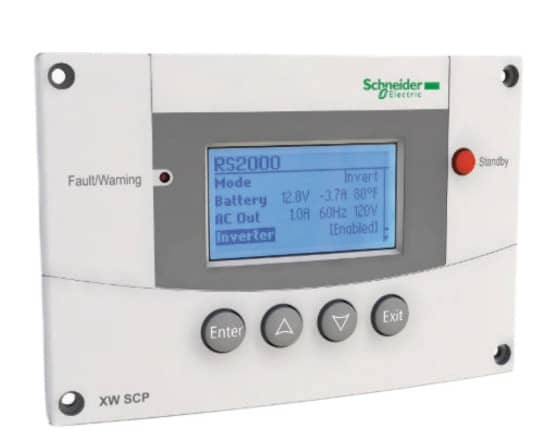
After installing a new set of lithium batteries this week on an older system, a neighbour, who had taken the customer’s old batteries, asked me to look at his system as well. He was missing a display unit, and without it I couldn’t access or change the system parameters.
Back at the office, I started searching for a replacement display. Nothing. They’ve been discontinued. This is a Schneider Conext SW 4048 inverter charger, installed only 3 years ago.
I remember a few years ago another solar company called me asking if I had one of these units in stock for the exact same reason. Schneider was moving away from the display and gearing towards an online approach and stopped producing them. At that time, the distributor I was using still had some of these left. This week, I can’t find one anywhere.
This is a major brand, one that was at the top of its field just a decade ago, and it’s slowly disappearing. Now the products themselves are vanishing too. The same story is unfolding with several of the biggest names that once dominated the off-grid world, Magnum Energy also have no more parts and no more support.
These older systems were built extremely well, and many are still running strong. But what’s replacing them is easier to install, more powerful, more affordable, and backed by 10-year warranties. That shift is becoming impossible to ignore.
Why Legacy Gear Is Being Displaced
The market isn’t rejecting these products because they were bad, in many ways they were better in their era. But the technology landscape has changed:
“All-in-one” hybrid inverter/chargers from companies like Sol-Ark, , GoodWe, Luxpower, Growatt and so many others now to name a few combine:
- MPPT charge controller
- Inverter
- Battery management
- Built in breakers
- Grid-tie & export control
- Remote monitoring
- ESS / load-shedding logic
- Lithium-ready battery support
All packaged in a single box.
That consolidation doesn’t just simplify installation, it changes the economics. Where legacy systems might require a separate inverter, multiple controllers, DC breakers, AC distribution panels, and associated wiring, hybrids reduce hardware, wiring time, failure points, and overall cost.
Moreover:
- Modern hybrid systems speak digital (CAN, Modbus, Bluetooth, apps)
- Firmware updates deliver features post-sale
- Batteries like lithium are natively supported
- Integration with grid-interactive modes and smart loads are built in
Legacy gear wasn’t designed for that world.
Cost and Value Are Shifting, Too
Old systems used to win on durability and expandability. But once:
- parts dry up,
- support dries up,
- field experience wanes,
- and brand ecosystems erode…
…the total cost of ownership rises faster than the up-front cost of modern gear.
A customer evaluating a 75 % older component with limited support versus a new hybrid that’s cheap, supported, and integrated, most will choose the modern option.
Why Victron Is Still in the Game
I believe Victron remains strong because they embraced smart technology early and built an ecosystem around it. Their equipment still works extremely well for smaller off-grid setups like RVs, boats, and cabins.
However, at least in North America, many of their inverter/charger models are not UL listed for residential grid-connected applications, which limits their role in full home grid-tie installations.
That said, in the off-grid world they are still serious contenders. Their systems are lithium-ready, offer robust online monitoring through VRM, and most devices are Bluetooth-enabled right out of the box. On top of that, they offer nearly every component you can think of to build and elevate a system, from charge controllers to DC-DC chargers to advanced monitoring and automation.
That complete ecosystem is a big reason they are still very much in the game.
When Smaller Systems Still Make Sense
We should also acknowledge that not every system needs, or can support, the newer all-in-one hybrids. Some customers simply can’t install enough solar panels to meet the higher PV voltage requirements of certain models. Others don’t need the 120/240V split-phase output that many of these larger inverters are built around.
In those cases, Victron and other similar brands still make a lot of sense. They are extremely flexible and work well in smaller-scale applications.
That said, when you look strictly at cost versus power, the comparison gets interesting. A fully built 3000-watt Victron system, once you include the inverter/charger, charge controller, Cerbo, GX display, breakers, and supporting components, can cost roughly the same as a 8000-watt all-in-one hybrid inverter. In simple terms, for the same money, you can get more than double the power with all of these features built and and also grid ready and also code compliant.
The main difference is that most of these newer hybrid inverters operate at 48 volts. Being over the 4000 watt threshold they need to be, from an efficiency standpoint, 48 volts is the voltage for larger systems, lower current, smaller conductors, and better overall performance. It’s hard to argue against that.
However, for smaller RV setups or compact cabins, a 12-volt or 24-volt system may still be entirely appropriate and more practical. Not every project needs to scale up to 48 volts, it just needs to match the real-world load and usage.
Conclusion
Legacy inverter systems served a generation, and many are still in the field today. But they are passing into history, not because people dislike them, but because technology, costs, support networks, and customer expectations have moved on.
If you’re designing systems today, or writing proposals for clients, the choice isn’t just about functionality anymore. It’s about future supportability, compatibility, and total cost of ownership.
And in that world, modern hybrid systems have already won.
IOTG SOLAR LTD 5 Critical Mistakes To Avoid Before Buying Solar.pdf
For individuals seeking consultation, education, or assistance in system designs related to grid-tie or off-grid solar applications, IOTG Solar stands ready to help. Our team is available to address questions, provide valuable insights, and offer support at every stage of the solar energy journey. Feel free to reach out to IOTG Solar anytime for expert assistance and comprehensive solutions tailored to your specific needs.
IOTG Solar…
Keeping you powered through education.