A Simple Off-Grid Solar Quiz:
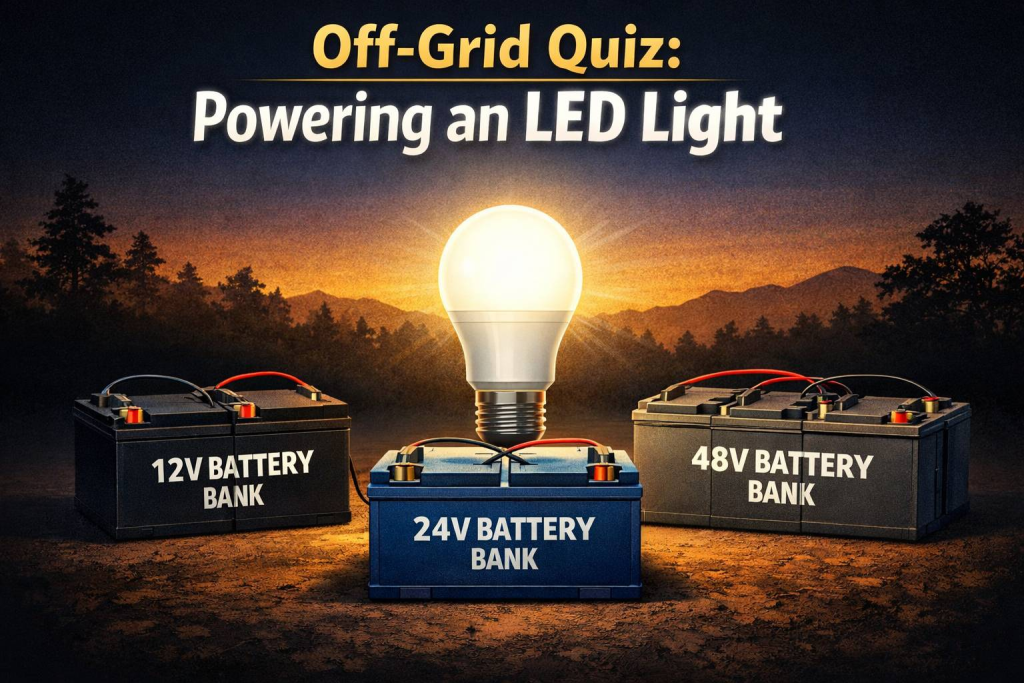
One LED Light, Three Battery Voltages

- Introduction
- The Answer That Surprises Most People
- So What Does Change?
- Why This Matters in Real Off-Grid Systems
- Conclusion
Introduction
As we head into a new year, I want to start with something simple, but powerful.
When people think about off-grid solar systems, the conversation often jumps straight to panels, batteries, and inverters. But real understanding starts much smaller. Sometimes it starts with a single LED light bulb.
Before reading further, take a minute to try this short quiz. No math degree required, just your instincts. Below the link we go through these scenarios together so go do the quiz first then read below.
The Answer That Surprises Most People
No matter which battery bank you chose: 12V, 24V, or 48V, the energy used by the light is exactly the same.
A 10-watt light running for one hour uses:
10 watt-hours of energy
That number never changes.
Voltage does not change how much energy the load consumes. The light doesn’t care what battery voltage you use, it only cares that it receives the power it needs to operate.
This is where many off-grid misunderstandings begin.
So What Does Change? Current
While the energy stays the same, the current drawn from the battery changes significantly as voltage increases.
Here’s the breakdown:
- 12V system: 10 watts ÷ 12 volts ≈ 0.83 amps
- 24V system: 10 watts ÷ 24 volts ≈ 0.42 amps
- 48V system: 10 watts ÷ 48 volts ≈ 0.21 amps
Same light. Same runtime. Same energy. Very different current.
Why This Matters in Real Off-Grid Systems
This is where voltage choice becomes more than a technical detail.
Higher current means:
- Larger wire sizes
- More voltage drop
- More heat loss
- Lower overall system efficiency
Lower current means:
- Smaller cables
- Less energy lost in wiring
- Longer, safer wire runs
- Better efficiency as systems grow
This is why small systems often start at 12V, medium systems move to 24V, and larger off-grid homes almost always end up at 48 volts.
It’s not because 48V “uses less power.” It’s because it moves the same power more efficiently.
Conclusion
If there’s one takeaway to carry forward, it’s this:
Voltage doesn’t change how much energy you use. It changes how efficiently you can move it.
Understanding that single idea puts you miles ahead when designing, upgrading, or troubleshooting an off-grid solar system.
If you’re planning a system this new year, or wondering whether your current setup still makes sense, start with the basics. They always tell the truth.
IOTG SOLAR LTD 5 Critical Mistakes To Avoid Before Buying Solar.pdf
For individuals seeking consultation, education, or assistance in system designs related to grid-tie or off-grid solar applications, IOTG Solar stands ready to help. Our team is available to address questions, provide valuable insights, and offer support at every stage of the solar energy journey. Feel free to reach out to IOTG Solar anytime for expert assistance and comprehensive solutions tailored to your specific needs.
IOTG Solar…
Keeping you powered through education.